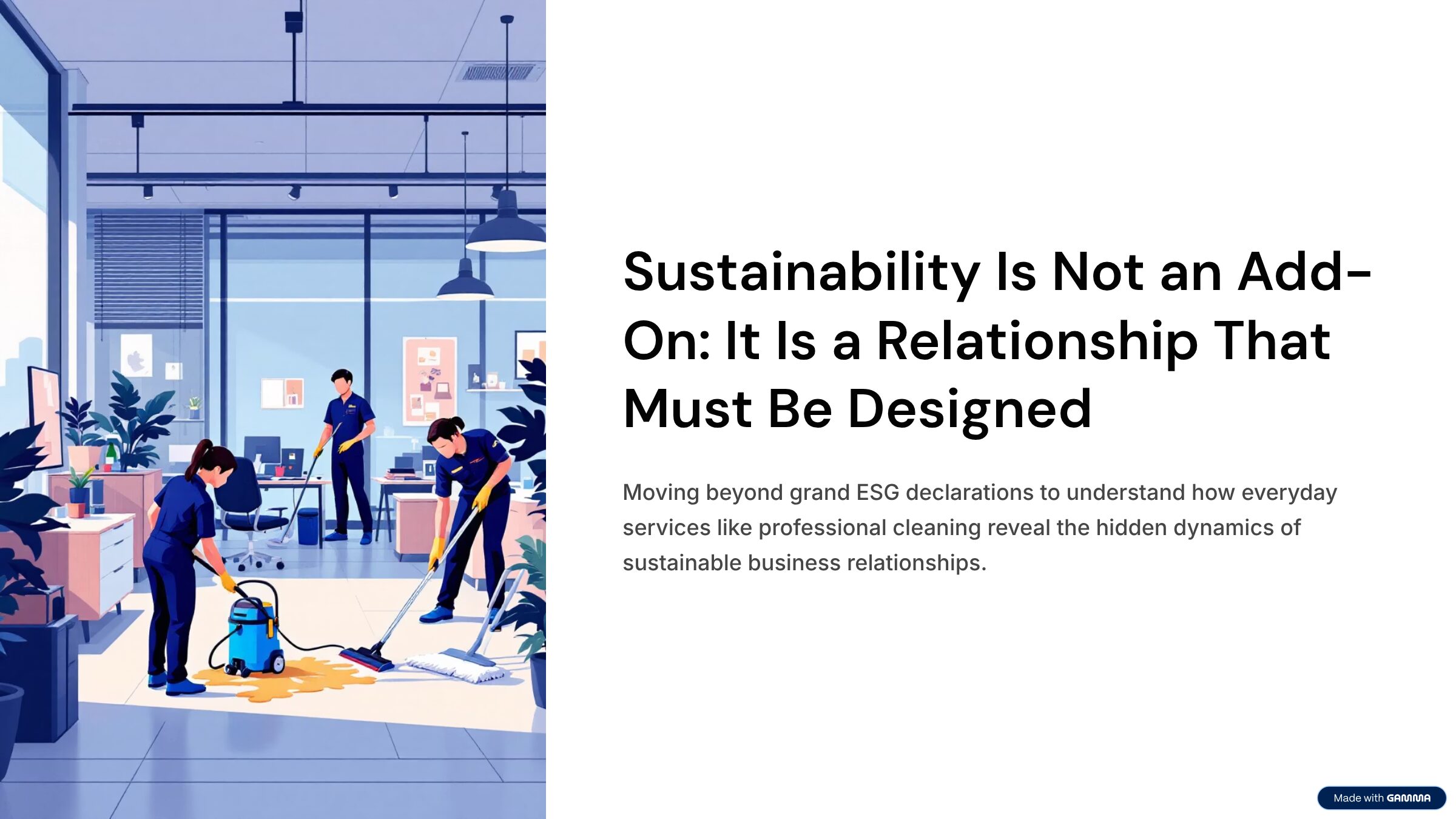
Sustainability Is Not an Add-On: It Is a Relationship That Must Be Designed
When we talk about sustainability in business, we often think in big terms: climate change, ESG indicators, public policy, or green technologies. Rarely do we look at everyday services, the ones that quietly sustain urban and economic life.
Professional cleaning is one of them.
At first glance, it seems like a simple transaction: someone cleans, someone pays. But this superficial view is precisely why many business models in this sector, and in many others, are fragile, unstable, and unsustainable over time.
Sustainability does not fail because of a lack of effort. It fails because we do not understand the system we are creating.
A Service Is Not a Task: It Is a Human System
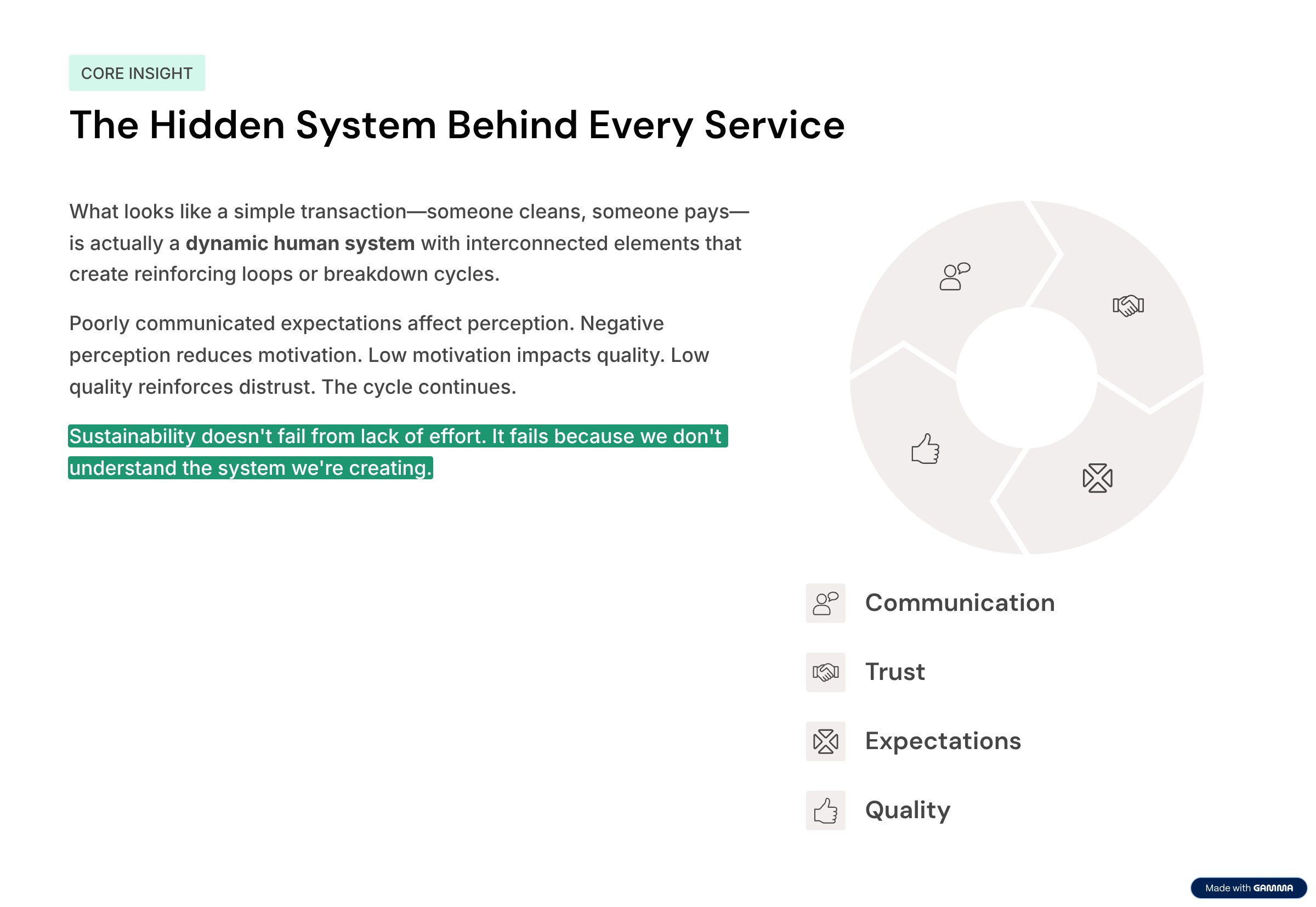
What appears to be a simple service interaction is, in reality, a dynamic human system composed of interconnected elements:
- communication,
- expectations,
- trust,
- motivation,
- feedback.
These elements do not operate in isolation. They influence one another and create reinforcing loops or breakdown loops.
Poorly communicated expectations affect perception.
Negative perception reduces motivation.
Low motivation impacts quality.
Low quality reinforces distrust.
And the cycle continues.
From a systems dynamics perspective, what is at stake is not a single cleaning session, but the long-term sustainability of the relationship.
Entrepreneurship Without System Understanding Designs Fragility
Many ventures fail not because the service is bad, but because the surrounding system is weak.
In the cleaning market, as in many service industries. a familiar pattern repeats itself:
- pressure to lower costs,
- little investment in communication,
- high staff turnover,
- dissatisfied clients,
- short-term relationships.
Each actor responds rationally to immediate incentives, yet the collective outcome is an unstable system.
System dynamics helps us see what is usually invisible:
the accumulated consequences of small, everyday decisions.
Sustainability Begins in the Invisible
When services are observed through a systems lens, it becomes clear that sustainability is not built solely through efficient processes, but through well-designed relationships.
Small actions generate multiplicative effects:
- setting clear expectations,
- recognizing good work,
- creating feedback channels,
- protecting team motivation.
These actions do more than improve a single cleaning session. They reinforce trust, reduce friction, and stabilize the system.
Over time, the system learns.
The Client Is Also Part of the System
One of the most important ideas in systems thinking is that there are no external actors. We are all part of the system we critique.
The client is not a passive evaluator of the service. Their actions, or lack of them, directly influence the outcome:
- how they communicate,
- what they expect,
- how they provide feedback,
- how they treat the team.
When clients understand their role within the system, they stop expecting perfect outcomes and begin to co-create sustainability.
System Dynamics Applied to Real Services
Inspired by the principles promoted by the System Dynamics Society, this approach translates abstract concepts into concrete decisions.
It is not about building complex models for every service, but about thinking in terms of relationships, feedback loops, and time.
The key question is not:
“Did this service work today?”
But rather:
“What kind of relationship are we reinforcing with each interaction?”
Entrepreneurship as the Design of Sustainable Systems
When entrepreneurship adopts this perspective, its purpose shifts:
- from optimizing efficiency alone,
- to designing stability,
- from constantly firefighting,
- to preventing problems before they escalate.
Sustainability stops being an external discourse and becomes an emergent property of the system.
A sustainable business is not one that never fails, but one that learns, adapts, and strengthens over time.
The Real “Why”
Connecting sustainability, entrepreneurship, and system dynamics is not an academic exercise. It is a practical response to an urgent question:
How do we design services that work today without eroding the relationships that sustain them tomorrow?
In sectors like cleaning, often invisible, this question becomes even more relevant. Because it clearly shows that sustainability does not depend on grand declarations, but on how we interact daily within the system.
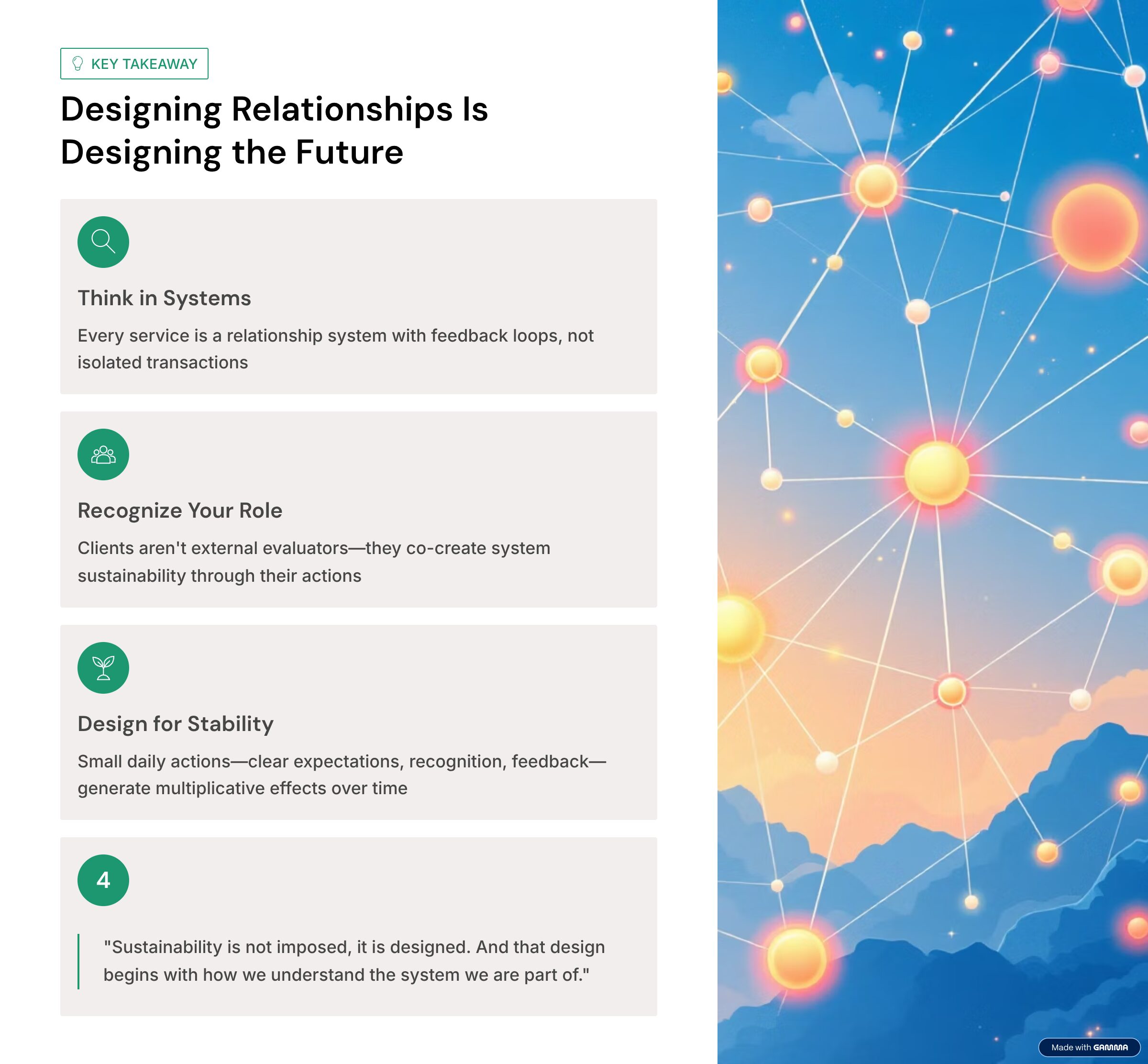
Designing Relationships Is Designing the Future
Every service is an opportunity to strengthen or weaken a system.
Every interaction leaves a trace.
Every decision reinforces a type of relationship.
System dynamics reminds us of something essential:
sustainability is not imposed, it is designed.
And that design begins long before visible results appear. It begins with how we understand the system we are part of.
Catalina Henao
Systems Dynamics Expert
2025