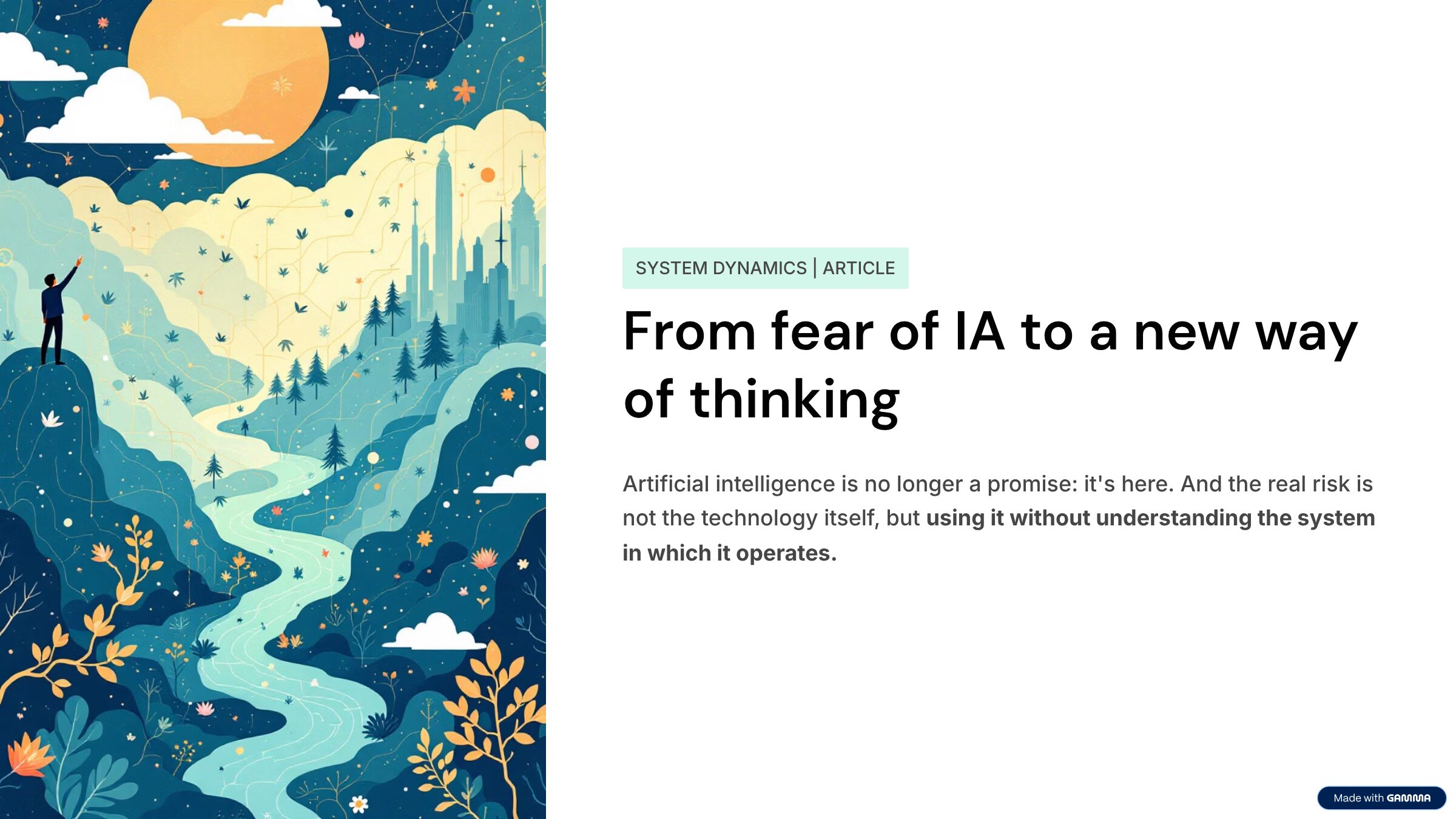
From fear of artificial intelligence to a new way of thinking: When System Dynamics enters the market
For years, artificial intelligence was viewed with distrust. Fear of losing jobs, of opaque decisions, and of systems that «think» without understanding the human context. In many academic and business spaces, the reaction was defensive: regulate, isolate, fragment.
But something began to change. Today, AI is no longer a future promise. It is here. It automates tasks, accelerates processes, writes code, analyzes data, and makes preliminary decisions better than many juniors. Fear is no longer theoretical: it is real.
And, paradoxically, it is precisely this moment that opens a historical opportunity to rethink how we design systems, markets, and organizations. This is where system dynamics enters a completely new level.
The problem was never AI, but how we think about systems
Public discussion is usually framed like this:
- AI yes or AI no?
- More regulation or more innovation?
- More academic programs in AI, cybersecurity, or data science?
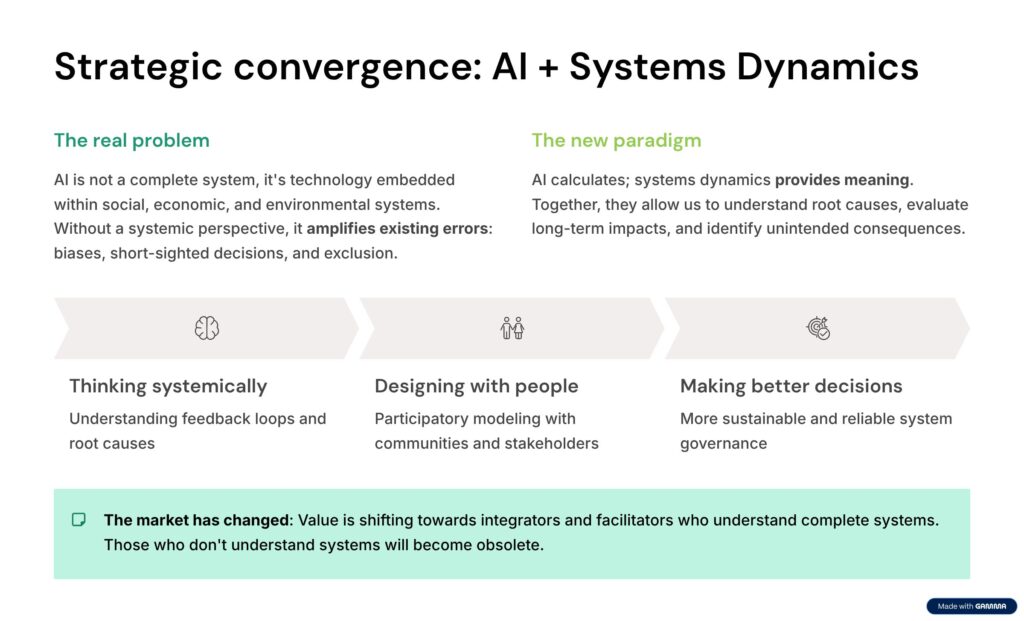
But this question is poorly formulated. Artificial intelligence is not a complete system. It is a technology within much larger social, economic, and environmental systems. When used without a systemic perspective, it amplifies existing errors: inequality, bias, short-term decisions, exclusion.
System dynamics has been warning about this for decades: complex problems are not solved by optimizing isolated parts. And today we are seeing it clearly. Creating hyper-specialized programs in AI without systemic thinking does not prepare one for sustainability or the real market. It further fragments an engineering field that was already fragmented.
The change has already begun: from fear to integration
The good news is that the change is already happening, though not always consciously. Organizations are discovering that:
- AI accelerates, but does not decide on its own.
- Models fail when they do not understand context.
- Algorithms need ethical and social explanations.
Here an uncomfortable but necessary truth appears: AI needs system dynamics to be responsible. System dynamics allows for:
- Understanding deep causes, not just correlations.
- Analyzing long-term impacts.
- Identifying feedback loops and unintended effects.
- Evaluating scenarios before implementing them in the real world.
In other words, AI calculates; system dynamics provides meaning.
A new level: AI + system dynamics in the market
For the first time, system dynamics ceases to be a niche academic tool and becomes strategic for the market. Why now? Because AI reduces one of the main historical barriers of system dynamics: the learning curve. Modeling, simulating, exploring scenarios, and facilitating systemic conversations no longer require years of technical training.
AI can:
- Help build initial models.
- Translate technical language into common language.
- Facilitate participatory modeling with communities.
- Accelerate scenario exploration.
This changes the game completely. System dynamics is no longer just for experts. It becomes a platform for conversation between technology, market, and society.
The market also changed (even if it doesn’t admit it)
There is a clear signal many prefer to ignore: purely technical junior profiles are no longer in demand. Not because engineering isn’t important, but because AI already does much of the initial technical work. Value is moving elsewhere.
The market is starting to look for:
- Integrators.
- Facilitators.
- People who understand complete systems.
- Professionals capable of dialoguing with communities, clients, regulators, and technical teams at the same time.
Here, system dynamics is not an «extra.» It is a core competency. Those who do not understand systems will become obsolete. Those who do will have a massive advantage.
Engineering without systemic thinking: a bad idea
In many countries, including Colombia, the institutional response has been to create more fragmented programs: AI, cybersecurity, data science. It’s not that these areas are unnecessary. Quite the opposite. The problem is developing them without a solid systemic base. That doesn’t solve current crises; it deepens them.
The challenges we face, inequality, climate crisis, loss of social trust, are not technical. They are systemic crises. And systemic crises are not addressed with isolated solutions. The engineering of the future cannot keep designing for the people; it must design with the people.
System dynamics as a bridge between technology and community
One of the most powerful contributions of system dynamics is participatory modeling: involving communities, stakeholders, and decision-makers in the construction of the model. This changes everything:
- Improves the quality of decisions.
- Increases trust.
- Reduces resistance to change.
- Generates more sustainable solutions.
AI, used correctly, enhances this process: it translates complex data, visualizes scenarios, and democratizes access to systemic knowledge. The result is not more technology, but better systems governance.
It is not a new idea. It already exists. We are just not using it. Universities and research centers are already working on:
- Community system dynamics, participatory engineering, model-based learning.
- AI + complex systems integration.
This is not futurism. It has already been invented. The problem is not the lack of solutions, but the resistance to changing mental models. We continue to reward short-term efficiency, incomplete metrics, and quick solutions that do not scale over time.
The true leap: changing how we think
The Earth4All report puts it bluntly: continuing as we are leads to «too little, too late». The alternative is the Giant Leap: transforming productive, educational, and social systems. And for that, we need more than just AI. We need applied systemic thinking integrated into the market, education, and public and private decision-making.
Artificial intelligence does not eliminate the role of the engineer. It redefines it.
- Less mechanical execution.
- More social responsibility.
- Less control.
- More facilitation.
Think better to use AI better
The fear of artificial intelligence was understandable. But today, the true risk is different: using AI without understanding the system in which it operates. System dynamics does not compete with AI. It elevates it. And this is the exact moment they converge: when the market, technology, and society finally need to think better to decide better.
Catalina Henao Tobon
Tebcal Corp Canada
Colombian Association of System Dynamics
Jorge Andrick Parra Valencia
Autonomous University of Bucaramanga
System Dynamics Society
International Council on Systems Engineering (INCOSE)
Colombian Association of System Dynamics
Antonio José Camacho University Institution
2025