Report: Technological LED Lighting Adoption in Colombia (2016)
This report outlines the findings of the 2016 research paper titled «Technological LED Lighting Adoption: A System Dynamics Approach,» authored by C. Henao and M. Becerra. The study utilizes System Dynamics (SD) to analyze the transition to LED lighting in Colombian households, focusing on urban consumption, market adoption, and the resulting impact on energy expenditure.
Overview of the Research
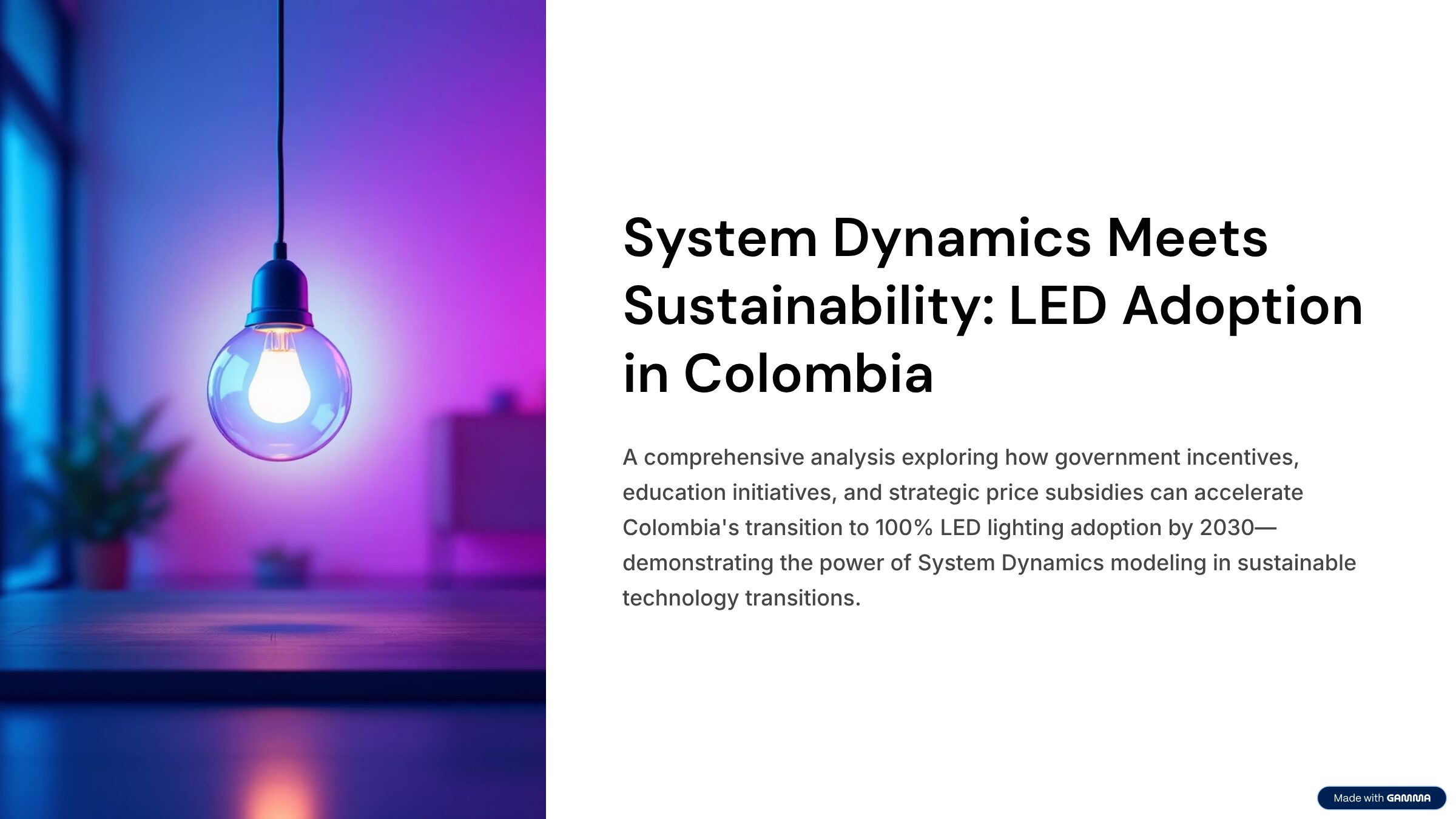
The primary objective of this investigation is to model the advantage of introducing renewable technologies like LED lighting to achieve 100% usage by the year 2030. The research highlights that LED adoption is not merely a technical change but a move toward energy efficiency, intelligent savings, and sustainability.
Key components of the study include:
- The Colombian Context: As a developing nation, Colombia’s adoption of new technology is tied to its unique political moment, focusing on sustainability and post-conflict development.
- Alignment with Global Goals: The study connects LED adoption to three of the UN’s Sustainable Development Goals (SDGs): Energy for sustainable development, sustainable and resilient cities, and the efficient use of resources.
- Barriers to Adoption: At the time of the study, Colombia lacked national companies producing complete LED products, necessitating imports and specialized assembly.
The System Dynamics Model
The researchers used causal loop diagrams to visualize the complex interactions between stakeholders, including the government and the lighting industry.
- Industry Dynamics: The model identifies a «Reinforcing Loop» where increased incentives for innovation lead to creative destruction, which in turn drives LED technology investment and sales.
- Government Policy: To achieve the 2030 goal, the model suggests that the government must provide price subsidies, education incentives, and foster institutional change.
- Environmental Impact: By switching to LED, which lacks the hazardous mercury found in some traditional bulbs, nations can significantly reduce carbon emissions and energy consumption.
Current Importance (Post-2016 Relevance)
Although this document was published in 2016, its relevance remains high today for several reasons:
- Approaching 2030 Deadlines: As the 2030 target for 100% efficient lighting draws closer, the paper’s framework for public policy and subsidies provides a necessary roadmap for remaining transitions.
- Climate Urgency: The need for trans-disciplinary cooperation to solve the climate change challenge is more pressing now than ever.
- Technological Evolution: The study correctly predicted that LED would become the source for all spaces due to its lower cost and longer lifespan compared to traditional radiation-based lighting.
Impact on System Dynamics and Entrepreneurship
This research serves as a valuable template for applied entrepreneurship and future modeling in the following ways:
- Strategic Planning for Startups: Entrepreneurs can use the concept of Creative Destruction, highlighted in the industry loops, to understand how disrupting traditional markets creates niches for profit and research.
- Decision-Making Tool: System Dynamics allows entrepreneurs and policymakers to learn about the potential implications of current decisions in an easy-to-understand, visual context, reducing uncertainty in complex environments.
- Social Entrepreneurship: The paper reflects the path of social entrepreneurs who empower companies through «Smart Savings» and low-carbon technologies, demonstrating how academic models can be translated into real-world business leadership.
——————————————————————————–
You can download the full document here