Report: The Feedback Method in International Trade Education (2009)
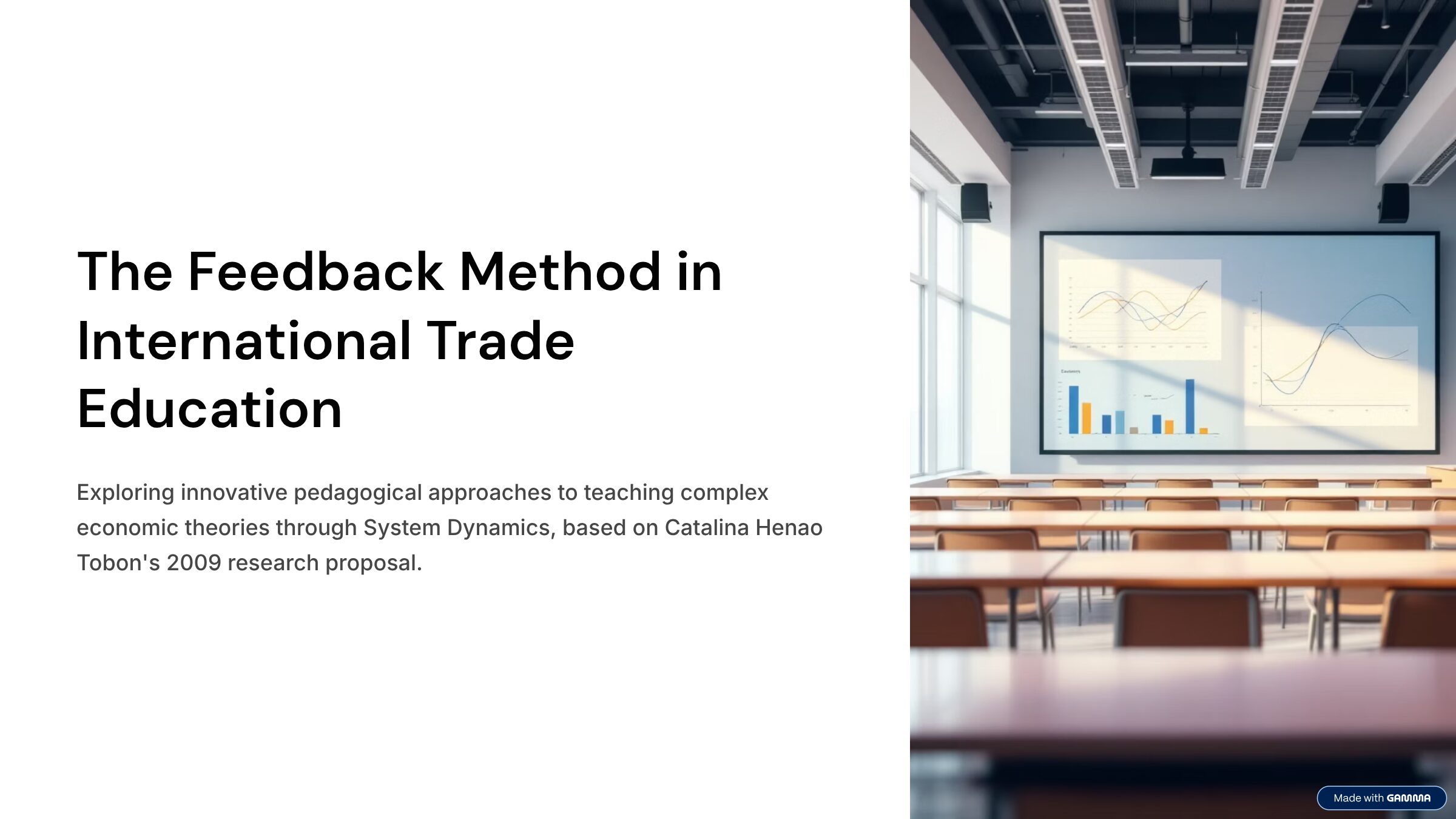
This report summarizes the 2009 research proposal by Catalina Henao Tobon, which explores innovative pedagogical approaches to teaching complex economic theories using System Dynamics (SD).
Overview of the Research
The document outlines a proposal for a controlled educational experiment designed to test the effectiveness of the «Feedback Method» in teaching International Trade Theories. Traditionally, these theories, specifically the Ricardian, Hecksher-Ohlin, and Economies of Scale models, are taught using static graphs.
However, the author argues that static representations often provide a misleading view of dynamic economic behavior. Instead of relying on complex mathematical equations, the Feedback Method utilizes causal loop diagramming and computer simulations (using software like Vensim or Powersim) to demonstrate how economic behavior emerges from structure.
The study’s central hypothesis is that students taught via the Feedback Method will not only prefer this approach but will also demonstrate a significantly deeper understanding of economic dynamics compared to those taught through traditional, static methods.
Current Relevance of the 2009 Proposal
While this research dates back to 2009, its core arguments remain highly relevant in today’s educational landscape for several reasons:
• The Persistence of Static Learning: Many modern economics curricula still rely heavily on static snapshots. The call for a «new kind of economics education» based on system dynamics, originally championed by Jay Forrester, is still a work in progress in many global institutions.
• Cognitive Retention: The document cites educational psychology to argue that unless information is placed into a structured pattern (a mental model), it is rapidly forgotten. In an era of information overload, the need for structured, systemic learning tools is greater than ever.
• The Shift Toward Simulation: The proposal’s focus on using «user-friendly computer models» to simulate behavior anticipated the current trend toward interactive and gamified learning in higher education.
Impact on System Dynamics Applied to Entrepreneurship
While the original document focuses on trade theories, the principles of the Feedback Method have a profound impact on entrepreneurship both today and in the future. (Note: The following insights on entrepreneurship draw on external information regarding the application of SD principles mentioned in the sources).
• Understanding Business Structure: Just as the method helps students see how trade behavior emerges from structure, entrepreneurs can use SD to visualize how their internal business processes (hiring, production, cash flow) create growth or stagnation.
• From Static Plans to Dynamic Strategy: Traditional entrepreneurship education often focuses on static business plans. Applying the Feedback Method allows founders to move toward dynamic strategy, where they can simulate «what-if» scenarios in a risk-free environment.
• Future Resilience: In the future, as global markets become more volatile, the ability for entrepreneurs to recognize feedback loops (such as market saturation or word-of-mouth growth) will be a critical competitive advantage. The transition from «static» thinking to «dynamic» simulation is essential for navigating complex, modern ecosystems.