Report: The Dynamic Inventory Problem of GM Dealers (2008)
Document Summary
This report analyzes the inventory crisis faced by General Motors (GM) dealers in the United States between 2003 and 2008. In a context defined by the burst of the financial bubble and the threat of a major recession, car dealers occupied a vulnerable position: they were the first to feel changes in demand but the last to be able to react to them.
The core issue identified is the steady rise in inventory levels over six years, even as sales were consistently falling. The document utilizes System Dynamics to model this behavior, identifying that inventory, which should serve as a buffer to handle market fluctuations, became an unsustainable financial burden due to high upkeep costs and a growing reluctance from banks to finance stock during the crisis.
Methodology and Systemic Structure
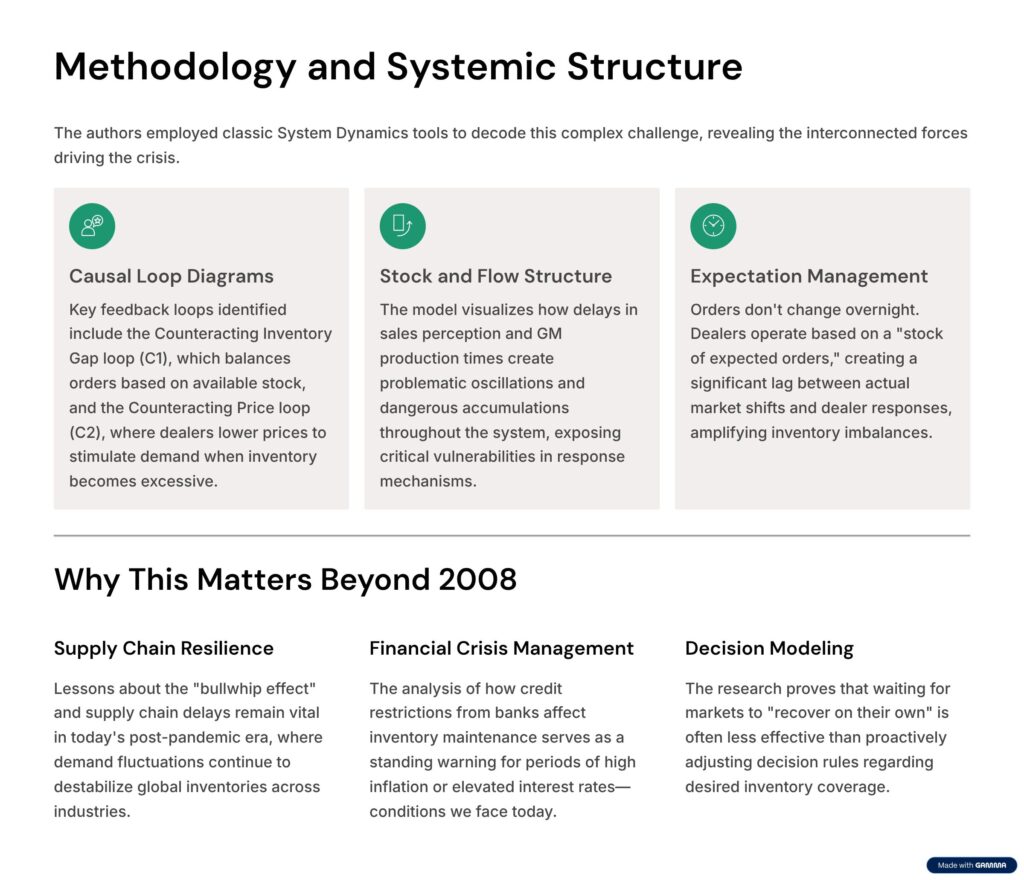
The authors use classic system dynamics tools to break down the complexity of the problem:
- Causal Loop Diagrams (CLD): Key feedback loops are identified, such as the Counteracting Inventory Gap loop (C1), which attempts to balance orders based on available stock, and the Counteracting Price loop (C2), where dealers lower prices to stimulate demand when inventory is excessive.
- Stock and Flow Structure: The model visualizes how delays in the perception of sales and production times at GM lead to problematic oscillations and accumulations in the system.
- Expectation Management: It is emphasized that orders do not change overnight; dealers operate based on a «stock of expected orders,» creating a lag in response to actual market shifts.
Current Importance (Beyond 2008)
Although the study dates back to 2008, its relevance remains high today for several reasons:
- Supply Chain Resilience: Lessons regarding the «bullwhip effect» and supply chain delays are vital in the post-pandemic era, where demand fluctuations have once again destabilized global inventories.
- Financial Crisis Management: The analysis of how credit restrictions from banks affect the ability to maintain inventory is a standing warning for periods of high inflation or elevated interest rates.
- Decision Modeling: The document proves that waiting for the market to «recover on its own» is often less effective than adjusting decision rules regarding desired inventory coverage.
Impact on System Dynamics applied to Entrepreneurship
From an entrepreneurial perspective, the insights from this 2008 investigation are invaluable for startups and scaling businesses. The application of System Dynamics in entrepreneurship, as demonstrated in the GM case, provides several strategic advantages:
- Understanding Delays: For an entrepreneur, understanding that there is a significant delay between a marketing action (such as a price change) and the actual market response is crucial to avoid over-ordering and burning through cash.
- Scaling Workforce and Capacity: The model shows that hiring and training (the Workforce loop C4) cannot happen instantly. Entrepreneurs can use these structures to plan growth capacity before they are overwhelmed by demand or crushed by overhead costs.
- Managing Growth vs. Stability: Startups often focus solely on the «Reinforcing Loops» of growth. This paper teaches entrepreneurs to identify «Balancing Loops», such as inventory costs and credit limitations, that could potentially bankrupt a fast-growing company if not managed holistically.
- Policy Testing: Instead of using trial-and-error in the real market, founders can use these stock and flow structures to simulate how different «desired inventory» policies affect their long-term survival.
Catalina Henao Tobon
System Dynamics Expert